I got the inspiration to have a go at making a raw adaption of a delicious vegan gluten free chocolate hazelnut cake I used to make for super special ocassions.
--
1 medium smallish beetroot that Joel's mum grew
Blended with a little water
And a good handful of juicy raisins and a banana
In a bowl mix with
Carob powder
A handful of chopped dates
a little salt and lemon juice
A tablespoon of melted coconut oil
2-3 tablespoons of freshly cracked and ground hazelnuts
And dessicated coconut
To form into a soft 'cake' mixture
Press into tart pan top with crushed hazelnuts and chill (to set)
Showing posts with label carob. Show all posts
Monday, December 20
Monday, December 13
Oh yeah mintandcarob so good
I was a bit low on immediately exciting things to put in my breakfast chia, for some reason my brain is really getting into juicy summer fruits. I ate 3/4 of a honeydew melon for dinner last night... anyway I trusted the process and ended up making a breakfast of pure brilliance all because of the mint!!!
--
4 spoons of black chia seeds soaked in a cup of water overnight
in the blender with
2 big spoons of carob powder
1 spoon of mesquite powder
handful of coconut flakes and raisins
some amazing fresh mint from Jet's garden
and I think that was it, no extra sweetner
really good flavour and texture with the chomped up pieces of coconut flake
--
4 spoons of black chia seeds soaked in a cup of water overnight
in the blender with
2 big spoons of carob powder
1 spoon of mesquite powder
handful of coconut flakes and raisins
some amazing fresh mint from Jet's garden
and I think that was it, no extra sweetner
really good flavour and texture with the chomped up pieces of coconut flake
Thursday, October 7
Raw? Organic? Local?
Carob powder is always roasted unless it's special raw carob powder. It's very hard to get so fine, and high temperatures are part of how they grind it so fine. That's one reason why you'll see that really raw carob powder is quite coarse compared to the normal stuff. Sheryl
Carob, the future?
I love carob.
I like it even more than chocolate.
I think you can get Australian grown?
Macarob, a south Australian carob farm, they appear to have been growing carob trees since early 80s but have sold out of all their carob? I think there's something going on here. More investigation needed.
Article on carob bean by the owner of Macarob
The process of breaking up the pod and separating the seed and kibble requires a regional processing facility. The pods are passed through a slow revving hammer mill with the output going to shaker/blower screens to separate out the seed and the kibble. Production must currently be exported as there is no local processing facility. It is estimated that a throughput of at least several hundred tonnes would be required for a viable processing operation for gum production.
Carob powder is made by gentle roasting and grinding. Carob syrup is made by dissolving the sugars and flavour and then concentrating the mixture to a syrup.
Australia currently imports about 1000 tonnes of carob gum per year at about A$5.00 / kg. However, the price fluctuates widely and in 1995 the price rose to A$32.00 /kg. Australia also imports about 60 tonnes of carob powder with a wholesale value of about $2.00 /kg. The cost of establishing a carob orchard is estimated at about $7500 per hectare with no return for at least 10 years. However, once the trees reach full bearing, returns should be about $10 000 per hectare.
fruit is a brown, leathery pod about 10 to 30 cm (4 to 12 in) long and contains a syrupy to biscuity flesh of an agreeable sweet taste, in which lie a number of seeds. The pods are edible and are often used for livestock feed
"The carob fruit, typically produced on female and hermaphrodite trees older than 6 years, is valued for a range of products derived from the seed and the pod. From the seeds, the endosperm is extracted for a galactomannan, which forms an edible gum (termed 'carob bean gum' or 'locust bean gum', LBG) and has become a valuable natural food additive. Carob powder, made by grinding the roasted pod, is used for the human food industry (with cocoa products and syrups). Ripe pods also have potential as a high energy stock feed. The gum is used extensively in Australia as an thickening or binding agent, particularly for canned pet food products. A study undertaken by Race, Curtis and Booth (RIRDC 1998) reveals that current imports valued at AU$10million/year. The current Australian demand for 'pet food' and 'technical' grade gum is estimated at 1200 tonnes/year, with a further 200 tonnes/year of the higher quality 'food' grade gum. Assuming a modern plant was built in Australia, the current Australian demand for carob gum could be met with approximately 2250 tonnes of carob seed (seed value at $ l600/tonne). This equates to 5405 ha of trees (at 104 trees/ha) with medium rainfall and low technology management (yielding 40 kg tree); or 1080 ha of trees (at 208 trees/ha) with supplementary irrigation and fertilising (yielding 100 kg/tree). As such, carob could be a commercial tree crop for landholders in the Murray Valley region.
From this article
The carob industry tries to go mainstream Article of ABC's Landline. The plot thickens...
Varieties of carob
I like it even more than chocolate.
I think you can get Australian grown?
Macarob, a south Australian carob farm, they appear to have been growing carob trees since early 80s but have sold out of all their carob? I think there's something going on here. More investigation needed.
Article on carob bean by the owner of Macarob
The process of breaking up the pod and separating the seed and kibble requires a regional processing facility. The pods are passed through a slow revving hammer mill with the output going to shaker/blower screens to separate out the seed and the kibble. Production must currently be exported as there is no local processing facility. It is estimated that a throughput of at least several hundred tonnes would be required for a viable processing operation for gum production.
Carob powder is made by gentle roasting and grinding. Carob syrup is made by dissolving the sugars and flavour and then concentrating the mixture to a syrup.
Australia currently imports about 1000 tonnes of carob gum per year at about A$5.00 / kg. However, the price fluctuates widely and in 1995 the price rose to A$32.00 /kg. Australia also imports about 60 tonnes of carob powder with a wholesale value of about $2.00 /kg. The cost of establishing a carob orchard is estimated at about $7500 per hectare with no return for at least 10 years. However, once the trees reach full bearing, returns should be about $10 000 per hectare.
fruit is a brown, leathery pod about 10 to 30 cm (4 to 12 in) long and contains a syrupy to biscuity flesh of an agreeable sweet taste, in which lie a number of seeds. The pods are edible and are often used for livestock feed
"The carob fruit, typically produced on female and hermaphrodite trees older than 6 years, is valued for a range of products derived from the seed and the pod. From the seeds, the endosperm is extracted for a galactomannan, which forms an edible gum (termed 'carob bean gum' or 'locust bean gum', LBG) and has become a valuable natural food additive. Carob powder, made by grinding the roasted pod, is used for the human food industry (with cocoa products and syrups). Ripe pods also have potential as a high energy stock feed. The gum is used extensively in Australia as an thickening or binding agent, particularly for canned pet food products. A study undertaken by Race, Curtis and Booth (RIRDC 1998) reveals that current imports valued at AU$10million/year. The current Australian demand for 'pet food' and 'technical' grade gum is estimated at 1200 tonnes/year, with a further 200 tonnes/year of the higher quality 'food' grade gum. Assuming a modern plant was built in Australia, the current Australian demand for carob gum could be met with approximately 2250 tonnes of carob seed (seed value at $ l600/tonne). This equates to 5405 ha of trees (at 104 trees/ha) with medium rainfall and low technology management (yielding 40 kg tree); or 1080 ha of trees (at 208 trees/ha) with supplementary irrigation and fertilising (yielding 100 kg/tree). As such, carob could be a commercial tree crop for landholders in the Murray Valley region.
From this article
The carob industry tries to go mainstream Article of ABC's Landline. The plot thickens...
Varieties of carob
A mud like desert
This is rough but delicious
2 tbs unhulled tahini
2 tbs almonds roughly broken up in mortar and pestle
2 tbs carob powder
1 grated fuji apple
2 tbs unhulled tahini
2 tbs almonds roughly broken up in mortar and pestle
2 tbs carob powder
1 grated fuji apple
Thursday, September 16
Post run
Today I started training again. After a foot injury and a few other momentum distractors it was really wonderful to go for s proper run. Before I left I meditated for an hour and then read the sections on "Nutrition during and immediately after exercise" in Brendan Brazier(vegan ironman)'s book Thrive. I ran 10kms down through the parks and along the river. It's so sustaining to connect with some kind of nature on a regular basis. Below are the "recovery drink" and "whole food smoothie" I made post run.
Whole food smoothie
An hour after my run I made this smoothie (the recovery drink at the end of this post is what I drank straight afterwards)
"A liquid meal shortly after exercise is of value because the majority of the bodys blood will be bust rapidly circulating throughtout the body clearing lactic acid and other metabolic waste from the extremities and delivering nutrients...with the extra strain of digestion removed by consuming complete liquid nutrition, recovery (from exercise) will dramatically improve." (Brendan Brazier, Thrive, p120)
--
2 segments of durian (my friend dumpstered amazing fresh durians imported from thailand, crazy that they get thrown out, too weird for normal people maybe? anyway the durian was able to lead a regenerated second life in my kitchen, thankyou world for the present)
2 cups of water
1 tbs unhulled tahini
1 tbs hempseed protein
1 tbs carob powder
1 tsp slippery elm
This was a really satisfying protein rich smoothie, and it tasted amazing!
Recovery drink - I made this straight after my run.
"What is consumed after the workout is vital for cellular reconstruction.. To speed recovery, the body needs simple carbohydrate to enter the blood stream - the quicker the better. This means that the post-exercise snack should contain very little fat and no fiber, since both slow the rate at which carbohydrate enters the bloodstream...as well as electrolytes lost in sweat." (Brendan Brazier, Thrive, p118)
Suggested in Brendans recipes are the use of dates, coconut water, blueberries and papaya which are all lovely but I don't have them. So I read his ideas and made my own.
--
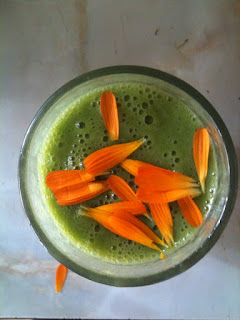
2 calendula flowers (the petals)
sprig parsely
2 cups of water
1/4 tsp pink salt
2 tsp maca (for adrenal nourishment)
1 tbs hemp oil
1 tsp wakame seaweed
1/2 large lemon
1 tsp raw honey
Whole food smoothie
An hour after my run I made this smoothie (the recovery drink at the end of this post is what I drank straight afterwards)
"A liquid meal shortly after exercise is of value because the majority of the bodys blood will be bust rapidly circulating throughtout the body clearing lactic acid and other metabolic waste from the extremities and delivering nutrients...with the extra strain of digestion removed by consuming complete liquid nutrition, recovery (from exercise) will dramatically improve." (Brendan Brazier, Thrive, p120)
--
2 segments of durian (my friend dumpstered amazing fresh durians imported from thailand, crazy that they get thrown out, too weird for normal people maybe? anyway the durian was able to lead a regenerated second life in my kitchen, thankyou world for the present)
2 cups of water
1 tbs unhulled tahini
1 tbs hempseed protein
1 tbs carob powder
1 tsp slippery elm
This was a really satisfying protein rich smoothie, and it tasted amazing!
Recovery drink - I made this straight after my run.
"What is consumed after the workout is vital for cellular reconstruction.. To speed recovery, the body needs simple carbohydrate to enter the blood stream - the quicker the better. This means that the post-exercise snack should contain very little fat and no fiber, since both slow the rate at which carbohydrate enters the bloodstream...as well as electrolytes lost in sweat." (Brendan Brazier, Thrive, p118)
Suggested in Brendans recipes are the use of dates, coconut water, blueberries and papaya which are all lovely but I don't have them. So I read his ideas and made my own.
--
2 calendula flowers (the petals)
sprig parsely
2 cups of water
1/4 tsp pink salt
2 tsp maca (for adrenal nourishment)
1 tbs hemp oil
1 tsp wakame seaweed
1/2 large lemon
1 tsp raw honey
Thursday, September 9
Get garden in
Friday, September 3
Carob cherry chia pudding
Today my mum and I are catching the train to Sydney. This was my breakfast, it was delicious, I wish I could eat it forever.
--
Chia seeds soaked in water to form a pudding like consistancy (like sago)
organic sour cherries
carob powder
a little salt and agave
--
Chia seeds soaked in water to form a pudding like consistancy (like sago)
organic sour cherries
carob powder
a little salt and agave
Thursday, August 26
Green Smoothie love
The green smoothie phenomena is quickly becoming a central part of my life. Everyday I pick greens and blend them with water and whatever fruit I can find. Everyday I invent a new recipe and find out you really can eat everything that grows (almost haha).Here are a couple of recent smoothies I really enjoyed
--
24.08.10
parsley and a few leaves of cos lettuce (from garden)
a grapefruit and 2 bananas
1 cup of water
-
23.08.10
fresh parsley
1 and 1/2 bananas
tablespoon each of carob powder and dessicated coconut
1 cup of water
--
22.08.10
(made with Chita)
milk thistle and nettles
1 orange, stick of celery and 2 bananas
3 cups of water
--
17.08.10
lots of spinach stalk and all
a small apple and half a banana,
spoon of tahini and a spoon of hemp protein
1 and 1/2 cups of water
--
11.08.10
lots of chickweed!
Spoon each of hemp, cacao and carob powders
4 squishy Turkish dates
1 banana and 1/4 of an avocado
1 and 1/2 cups of water
--
another version of chickweed chocolate!
04.08.10
chickweed!!
Half an avocado
1 banana and 3 strawberries
raw cacao and maca powder to taste
a tiny bit of agave of you need to balance sweetness
1 and 1/2 cups of water
(by all the exclamations you can probably see I am fond of chickweed-chocolate smoothies...)
--
01.08.10
buk choy leaves
2 bananas and 3 strawberries (these were high flavoured organic strawberries so don't need many, also I don't generally use much expensive fruits in my smoothies, since the high proliferation of bananas, I buy ripe ones from the markets and keep in freezer, I do the same with avocadoes sometimes-removing skin, quartering and freezing-rationing)
spoon of maca
1 and 1/2 cups of water
Wednesday, August 25
Carob tahini hemp ball
I've made these a few times in the last week, I'm a bit into carob at the moment, it's so aromatic and delicious. Depending on quantities you have available and particular taste (whether you want an intense flavour or more sustenance) this concept is very adaptable. Yesterday I made it like this
--
1 cup of ground sunflower seeds
1-2tbs coconut oil melted
1-2tbs tahini
1-2tbs raw honey
1-2tbs carob powder
1 cup of hempseed protein
juice of an orange
--
the previous day I made a version without the sunflower seeds and much less hemp, they were deliciously rich, this recipe above is a sustenance version. Hemp is super high in protein.
--
1 cup of ground sunflower seeds
1-2tbs coconut oil melted
1-2tbs tahini
1-2tbs raw honey
1-2tbs carob powder
1 cup of hempseed protein
juice of an orange
--
the previous day I made a version without the sunflower seeds and much less hemp, they were deliciously rich, this recipe above is a sustenance version. Hemp is super high in protein.
Subscribe to:
Posts (Atom)


